
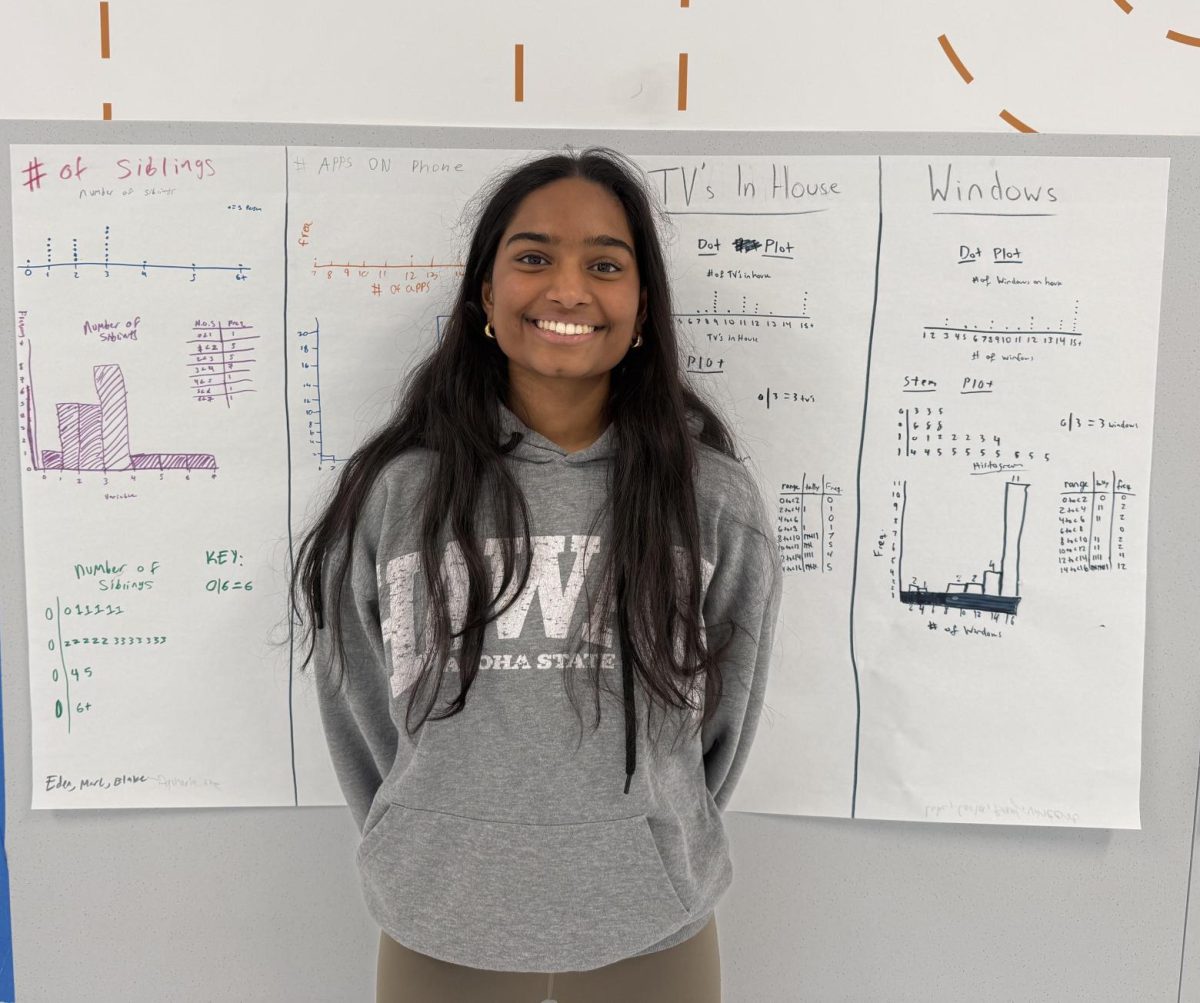
AP Statistics students are moving beyond textbooks to design unique experiments that tackle deeply ingrained social biases, giving their statistical training powerful real-world relevance.
Jenna Song (12) is investigating the conflicting visual cues of wearing glasses, exploring how this single accessory impacts the assumption of how many hours she spends gaming. She acknowledges that the stereotype cuts both ways.
“Some people could view glasses as academic so they won’t think we game as much,” Song said. “On the flip side, other people could think that we have glasses because we play so much staring at a screen.”
This paradoxical nature of the glasses stereotype means the data collection phase will be telling in determining whether the “academic” or the “gamer” assumption prevails.
“We haven’t been able to go out and collect data yet, but I’m excited to see what people say,” Song said.
Meanwhile, Sahasra Mandalapu (12) is tackling an equally interesting bias: the judgment assigned based on a person’s educational pedigree. Her study seeks to isolate whether institutional prestige alone can sway opinions on the quality of a piece of writing.
“As high school seniors currently in the college application process, we frequently hear assumptions that elite schools automatically have and produce ‘smarter’ or ‘better’ students,” Mandalapu said.
Noticing these assumptions daily, Mandalapu is eager to use statistics to expose the underlying prejudice that often accompanies discussions of higher education.
“By studying this topic, we can observe how societal stereotypes about education and prestige shape opinions,” Mandalapu said.
This hands-on research transforms abstract lessons on bias into a vivid, immediate exploration of human perception. The students are effectively bringing complex theory to life through practical observation.
“I think this project is really interesting, and it’s a fun way to see what we’ve learned in AP Stats class about bias in action,” Mandalapu said.