When you read Wuthering Heights, you have to be prepared for heartbreak. The ache of watching two characters who are so similar, so flawed, so deserving of love and knowing they’ll never get it. The pain of knowing what could have been. After watching the movie, I’m still heartbroken, but for all the wrong reasons.
Let’s get one thing straight: Wuthering Heights is not a love story. In my opinion, it’s more about the cycle of abuse than it ever was about romance. After dealing with abuse from Catherine’s older brother, the isolation of their home, near-constant neglect and more, she and Heathcliff are so broken that even when love falls into their lap, they can’t have it. Their relationship, and its tragic end, is a direct result of their trauma, carried from generation to generation, poisoning everything it touches. I loved how the author, Emily Brontë, showed that in the novel: unflinchingly, no sugar-coating.
The movie wipes all of that away.
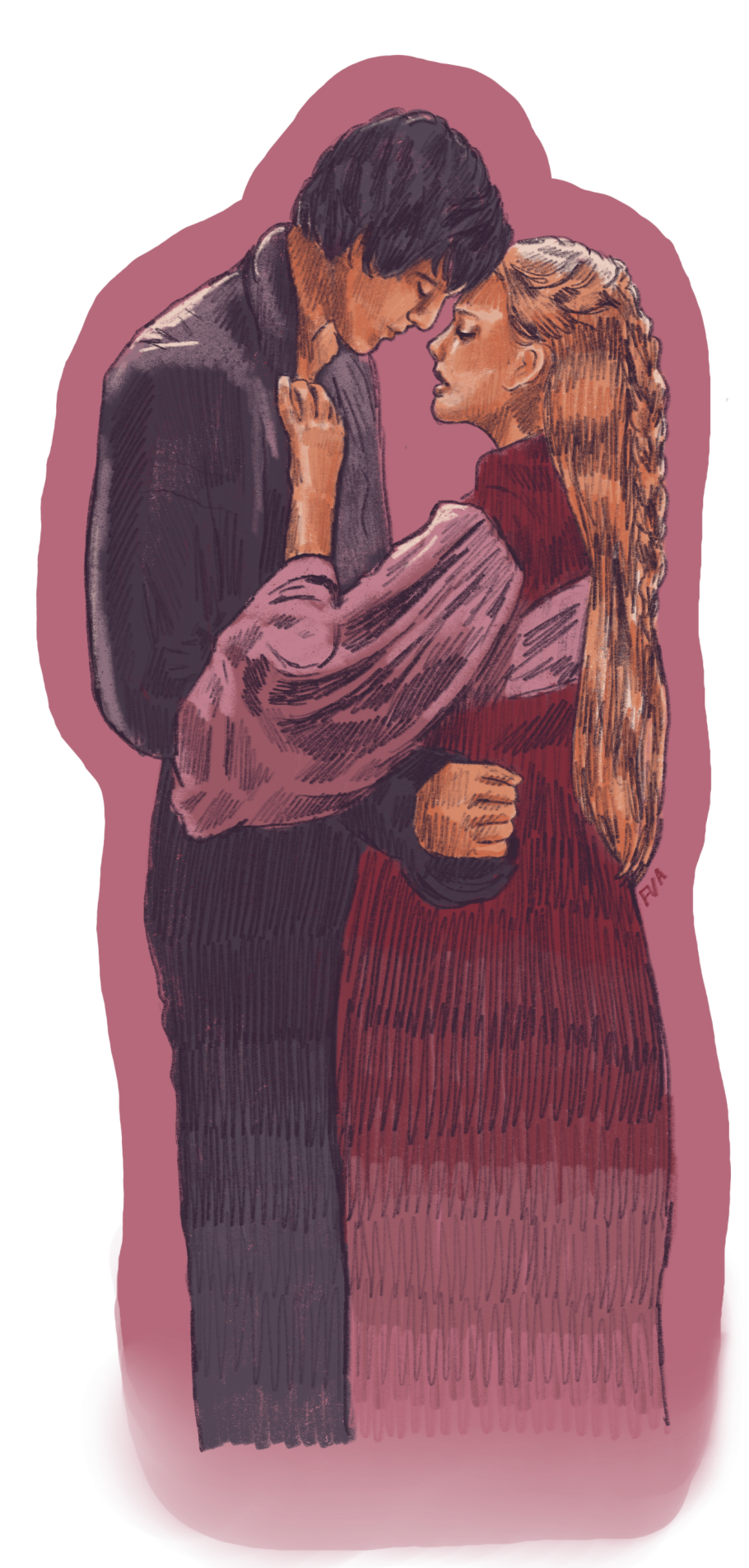
I knew from the marketing — “the greatest love story of all time” — that I was getting romance. Still, I was hopeful that the story’s darker themes could be realized. But inexplicably, the pain in Wuthering Heights is erased. There’s no abusive older brother; instead, Catherine’s father becomes a weak imitation. We get a glimpse of Heathcliff and Catherine’s childhood, just barely showing how neglected they were, how they only had each other.
Most egregiously, we lose the story of the next generation, which makes up the entire second half of the novel. This, at least, isn’t just the movie alone — many adaptations have done this — but I hate it. Without Catherine II, Linton and Hareton, we lose the resolution to the cycle, the depth that makes Wuthering Heights so great. The movie tries to make up for it with kinky romance, R-rated intimacy and even opening with an execution. This effort feels cheap compared to the novel’s emotion.
Everything feels hollow in this movie. Every character is a shadow of their former self. Catherine, who is headstrong and passionate and, yes, unlikable, but for good reason, has all the maturity of a 6-year-old in this remake. Heathcliff is actually villainous in the novel; here, he’s just an edgier Jacob Elordi, a whitewashed facsimile without any real venom. Don’t get me started on Isabella’s character destruction. I’m still traumatized by that “pet” scene.
What breaks my heart is that this movie had so much potential. There are moments when I can almost see the novel I love: in the admittedly beautiful moors, the vibe of the set, the crumbling stone and sky. In the scene where Heathcliff cries over Catherine. In the flashbacks to their childhood, however brief.
But mostly, the tragedy of Wuthering Heights is smoothed over, modernized, erased. This movie seems to say that everything the characters experience, all their rough edges and flaws, isn’t enough to keep us entertained. Like Catherine and Heathcliff can’t be loved by the world if they’re not baring it all in a trashy romance. Like if Wuthering Heights isn’t modernized, then nobody will care. Not only is that disappointing, but it’s also just wrong.
This movie is beautifully shot. It has gorgeous music. An all-star cast. It will probably be a wild success. But for all its marketing, its showboating, its desperation — it can only ever be a muffled cry of the original.