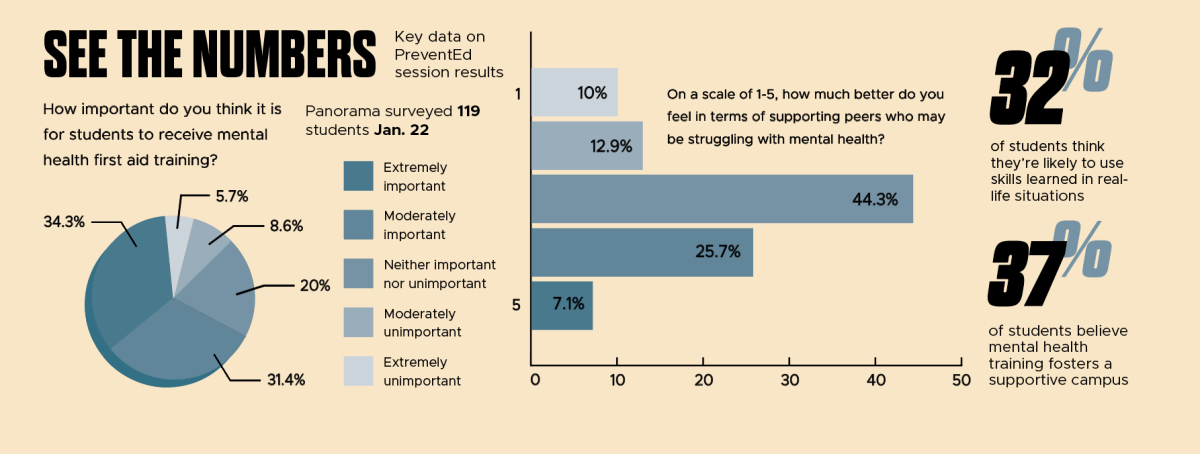
Students learned how to provide initial support to peers facing mental health and substance abuse challenges and during PreventEd’s Teen Mental Health First Aid course Jan. 8, 12 and 14.
PreventEd, a local nonprofit focused on preventing substance abuse through education, intervention and advocacy, held three sessions during Home Lab and seminar. Teen Mental Health First Aid was targeted at empowering students to reach out for help — both for themselves and their peers.
“PreventEd is one of our community partners offering counseling services to students,” Sophomore Counselor Leah Jones said. “We [implemented] the Teen Mental Health First Aid program two years ago because we saw a greater need in our student body. Freshmen who take health class participate in a program [about] signs of suicide, so we thought it would be nice to continue the mental health discussions through PreventEd.”
PreventEd Community Strategist and Counselor Emily Wilkerson helpedteach training sessions at Ladue. She emphasized the organization’s views on mental health education as crucial for preventing long-term substance abuse.
“PreventEd takes a multi-pronged approach,” Wilkerson said. “By holistically approaching substance use prevention, our vision is to have a community free of alcohol and other drug misuse and related problems. We believe that when communities understand mental health, they are better equipped to support one another.”
For students like Austin Singer (10), PreventEd’s approach proved worthwhile in shifting perspectives on mental health.
“I noticed that [PreventEd] went into depth talking about many types of mental health challenges, especially the reasons behind them,” Singer said. “Reaching out is the best way to overcome mental health challenges. You don’t have to go through the challenge alone because there’s always helpful resources who won’t judge at all.”
As students navigate high school, stress can become prevalent. However, PreventEd provides skills and tools to manage those challenges beyond graduation.
“Teaching students how to handle everyday stresses is so important because that feeling is going to be present in high school, a job, a college setting and all throughout life,” Jones said. “Teaching people how to navigate those are important skills.”
Educators hope these standards will form what is to become a lasting change in societal views on youth mental health.
“My hope is that raising awareness about mental health challenges and protective factors will create a wave of change,” Wilkerson said. “The only way things will improve in the world is by supporting and encouraging young people to be exactly who they are. I hope by seeing an adult passionate about the mental well-being, the ripple will continue in our communities.”

![Team representatives Hotaru Murashita (11) and Regina Copeland (10) play rock paper scissors for the winning prize. The club hopes to continue to implement new meetings every year. “About a month ago, we pitched [the idea], and Madame Milford helped us obtain the croissants and jams,” Secretary Arlo Ziolkowski (11) said.](https://laduetoday.com/wp-content/uploads/2026/04/FHS-April-8-1200x900.jpg)