-
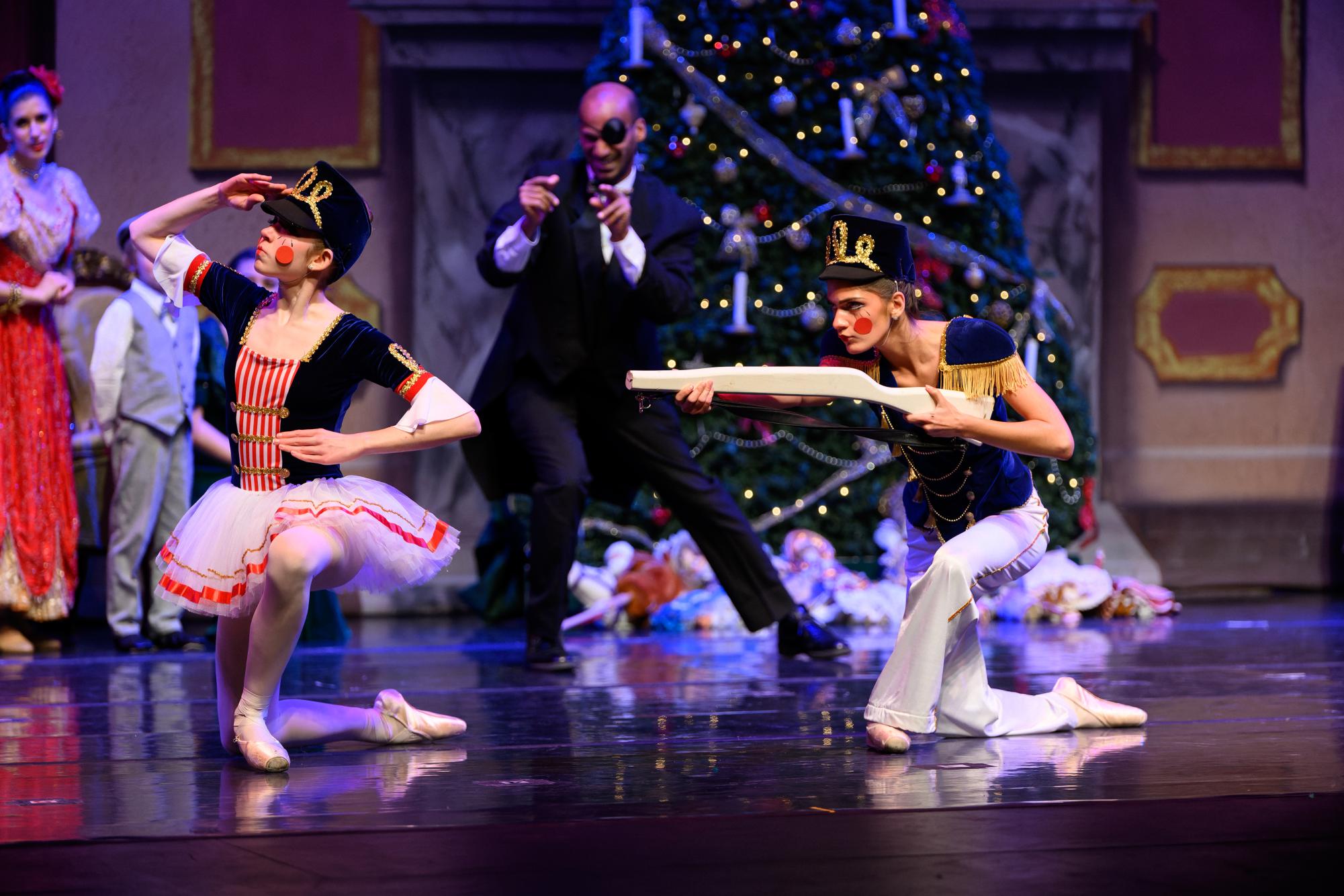
Jo Gyawali (12) acts as a toy soldier doll during Clara’s Christmas party scene. This was Gyawali’s seventh Nutcracker. “I really like being in front of an audience,” Gyawali said.
-
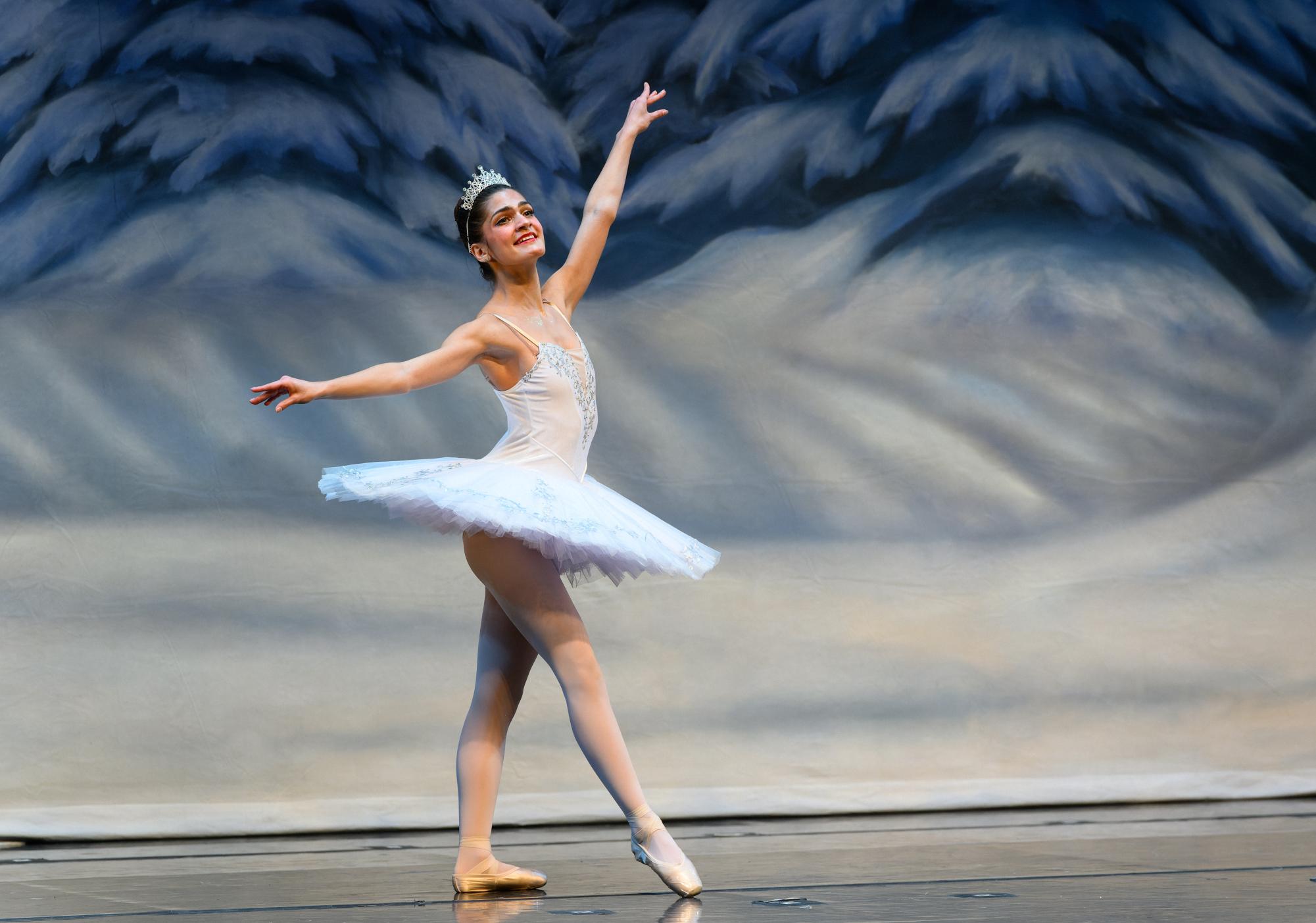
Gyawali dances as Snow Queen. She performed five roles. “As you get older, you get more difficult roles,” Gyawali said.

Surrounded by the soft shuffle of dancers pacing backstage and the glow of vanity bulbs, Jo Gyawali (12) carefully places four bobby pins at the front of her headpiece. Each pin is more than a clip, but part of a pre-performance ritual that anchors her costume and her mind.
Gyawali has been dancing for 16 years and has performed in the Nutcracker every year since she was in seventh grade. The annual holiday tradition that occurs around Thanksgiving weekend requires immense dedication and commitment from the dancers. The roles were released in June, beginning with sparse rehearsals over the summer and quickly shifting to a strenuous schedule once the school year began.
“Over the summer, everybody has jobs or is going out of town,” Gyawali said. “As soon as the school year starts, we have 30 minute rehearsals after our two hour dance classes on Mondays and Wednesdays, and we have seven hour rehearsals every Sunday from about the middle of August until Thanksgiving weekend.”
During these long rehearsals, the cast runs through the entirety of Acts 1 and 2 without pause, stopping only to review notes made throughout the performance. Afterwards, they participate in a team bonding activity before being dismissed.
“When we’re rehearsing, we try to do it as accurately to the performance as we can,” Gyawali said. “[My instructor] writes down notes in her notebook as [we dance] and [after], she tells every person what corrections they need to make. It’s a [time to focus on] anything that needs to be fixed like spacing, placement or symmetry.”
While the rehearsal schedule can be very demanding, the cast has built a powerful support system to help navigate the pressure. As the only senior on cast this year, Gyawali created Nutcracker families, pairing older and experienced dancers with younger dancers to help them get used to the Nutcracker’s unique running order.
“Nutcracker families are really fun,” Ladue student Sophia Wilson (9), Gyawali’s teammate, said. “We get together with our families that the [older dancers] lead, and we have a chance to ask questions, help each other with quick changes between scenes and keep each other happy. It’s really good for the younger girls that don’t know everything [about] Nutcracker yet.”
Once the long rehearsals and backstage rituals are complete, the final step is mental preparation and visualization before taking it to the stage. Gyawali and her teammates take a deep breath together before leaning into their teacher’s motivating words.
“My dance teacher says, ‘perform like you’re dancing to the heavens,’” Gyawali said. “This means to perform up and out, rather than to the people in front of you. There’s a balcony [in the theater], and she always jokes that since dancers are typically paid less, they usually get the worst upper seats. So you want to perform for the dancers, and to the heavens too.”
![Linnea Nystrom (10) guides her
crew back to the boathouse
at the end of practice Feb.
24 at Creve Coeur Lake. This
was Nystrom’s first season as
a part of the St. Louis Rowing
Club after moving from New
York City, and prior to that,
living in California. “Theres a lot
of interpreting what [coach-
es] want you to do or say,”
Nystrom said. “You have to
know them really well to know
what they would want you
to do in a specific situation.
Especially on race days when
they’re not going to be there
the whole time. You need to
take charge and emulate what
they would want.”](https://laduetoday.com/wp-content/uploads/2026/03/LINNEA-1200x783.jpg)