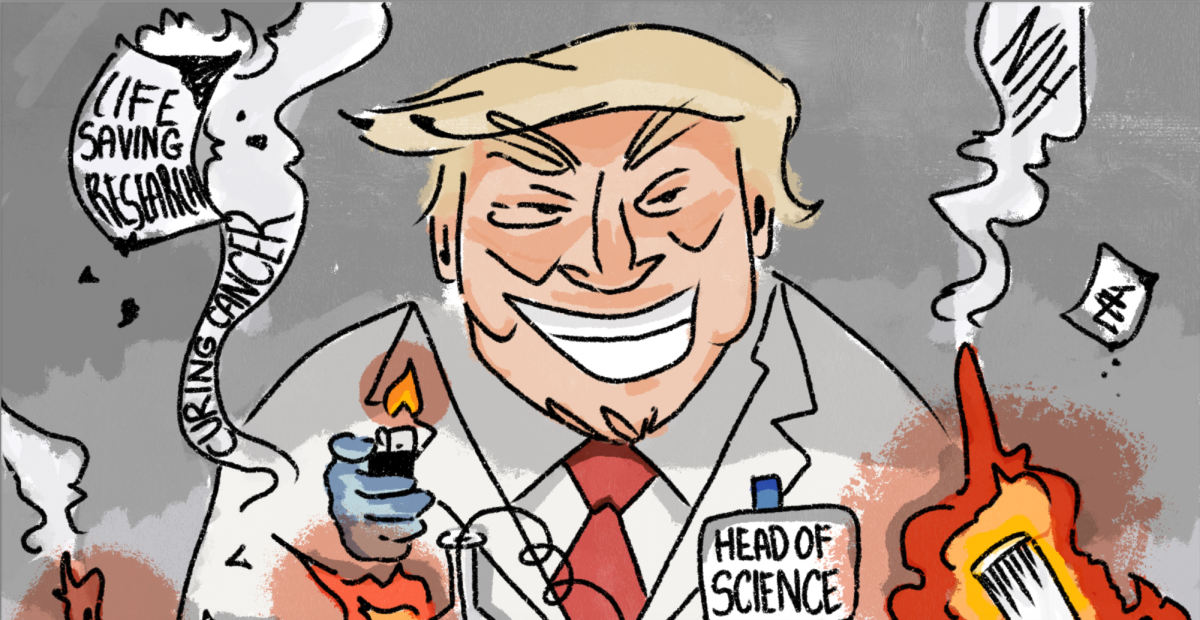
Jobs lost, dreams crushed. Life-altering discoveries thrown out the window. That’s the reality of today, in which the federal government froze billions of dollars of essential scientific research grants for being deemed wasteful and “woke”. But in reality, this policy shift sacrifices scientific integrity for political ideals, resulting in grave harm to research progress and public well-being.
The fundamental stability of modern life — from satellite forecasts to medical vaccines — is the direct product of decades of sustained federal support. If not for the life-saving research funded by grants distributed through institutions like the National Institutes of Health (NIH) or the National Science Foundation (NSF), the lives of millions and potentially billions globally
would be shorter and sicker. However, the very government that established these indispensable institutions is now jeopardizing their life-saving work.
These effects are widely apparent in the field of public health. Earlier this year, a landmark longitudinal study on women’s health was terminated due to federal funding cuts, ending decades of data collection on chronic disease and aging for tens of thousands of women. Similarly, a separate federal research project was shut down, leaving patients with experimental drugs and devices still in their bodies, without access to the clinical oversight they were promised. This elimination of scientific research and care was only justified because of its supposed connection to diversity, equity and inclusion (DEI), which became a convenient justification to defund initiatives that help the most vulnerable.
The federal government backs these actions, arguing they detract from core department missions or represent fiscal waste. This perspective, however, fundamentally ignores the impact of these grants: supporting essential S.T.E.M research and crucial, life-saving infrastructure focused on un-deserved communities. When these grants are cut, opportunities for future scientists
are eliminated, innovation slows down and society ultimately pays the price.
Beyond the crucial public services already highlighted, damage is being applied to the foundations of science. Thousands of existing scientific public records have been scrubbed from the internet under federal jurisdiction, creating data gaps able to set back years of progress. Universities, grappling with a new reality that federal funds for research are no longer present, are forced to face a social dilemma: to keep academic freedom and integrity, or succumb to the pressures of fiscal mandates.
It’s clear that the integrity and progression of science under this federal government are no longer valued. The Trump administration has appointed proponents of widely disproven theories to lead significant scientific federal departments, such a an anti-vaccine activist sitting as secretary of Health and Human Services. These actions, coupled with the national scrubbing of STEM-based research, actively work against scientific and societal progress. Consequently, the abrupt halt in foundational research funding deters the next generation of scientists and scholars from pursuing careers in fields now deemed unstable and politically vulnerable.
The integrity of scientific funding directly dictates our ability to withstand disaster. Agencies like the Federal Emergency Management Agency (FEMA) rely on advanced scientific grants for the predi tive modeling and tools necessary to save lives. St. Louis, for instance, uses these science-based funds for proactive mitigation against events like the EF3 tornado that ravaged the city in May. Attacking the research grants intended for these predictive capabilities and cutting the federal workforce jeopardizes every local safety net.
This instability very much affects the future of our community. A significant portion of Ladue’s population plans to pursue STEM-based careers, fields that rely heavily on the federal funding of institutions like the NIH and NSF. When these scientific foundations are demobilized by cuts based on non-scientific grounds, not only are advancements stalled and lives put at risk, but the long-term stability of those career paths is also impacted.
That’s why we must act now to address the current administration’s actions towards federal research, whether it’s by making our voices known through political advocacy or starting small through social media advocacy. Our voices might not mean much on their own, but together, we can start a movement.