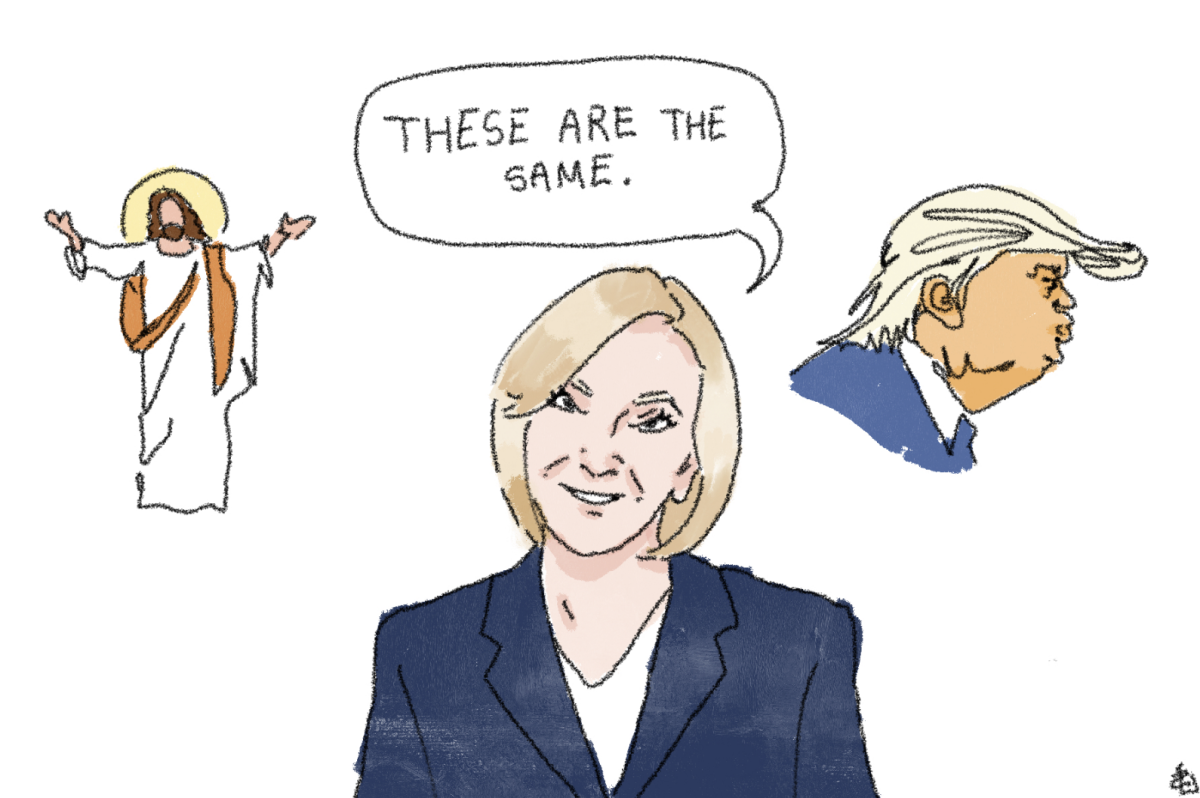

I’m so proud of myself. I saved the world today. It was so simple, I just logged on to Instagram and pressed three buttons. You’d best thank me the next time that you see me. After all, my Instagram story did end gun violence in the United States of America.
While this is obviously hyperbolic, the vast ocean of political content on social media is not. We have entered an age where seemingly every single brand, activity and belief has a blue or red tint. The politicization of ephemera has created a situation in which so-called “political issues” are encountered constantly. This motivates virtue signaling where individuals support certain sides of political disputes in the same way that they would express their love for a particular musical artist. Virtue signaling in this way has been termed as performative activism.
Per the doctrine that “everything is a political problem,” performative activists inject politics into issues that are tangentially related. This becomes a problem itself–given that certain issues should be viewed through a moral lens, not a political one. By putting every issue into political terms, it forces such issues to only be discussed in light of the binary political system, which makes consensus virtually impossible.
Let’s look at the last flashpoint for such “activism.” A horse beat so far to death that its soul has evaporated: the death of conservative debater and activist Charlie Kirk. His death has truly demonstrated that people love to feel like they are doing something. Let’s talk about some of my “favorite” stories that I saw Sept. 10. “GUN VIOLENCE SPARES NO ONE.” “Gun violence doesn’t care about ideology.” “You’ll Remember Charlie Kirk? Now Name One Palestinian.”
Ok, so what did we learn here? Not a whole lot. Two true statements, and a third that attempts to inject shame into the decision of who someone chooses to follow politically by throwing out an egregious whataboutism regarding the genocide in the Gaza Strip.
I absolutely think that conversations about gun violence are necessary. I believe wholeheartedly that these kinds of events deserve to be talked about. But, if your immediate response is to turn to posting on social media–then something is wrong. This is for a few reasons.
Primarily because it only propagates media illiteracy in an infinitely large echo chamber. It starts with the people that see what happened first. Immediately upon opening social media, they see a post. Maybe it is from the New York Times, Politico or Rap TV. Regardless, they see said post, and share it to their story–offering up the valuable information that they have newly discovered to their awaiting supplicants.
The frightening capability of social media is that it removes the need for critical thinking. We enter a herd mentality, where our feeds are inundated with content that validates our beliefs. No real political discussion can occur as long as spaces for constructive debate don’t exist. Screens have created an environment in which individuals are able to shield themselves in thousands of other people that think, act and look the exact same as themselves.
The only way that structural societal problems–like gun violence–can be solved is if opposing viewpoints can be understood by the other side, and common sense reforms can be made. Herein lies the problem: everyone, especially our lawmakers, have hid themselves inside echo chambers in every waking moment.
Social media survives off of trends, and when those trends dry up, the almighty algorithm moves on. Trends, by nature, are only prominent for a short time. As a condition of this, when political topics are trending, it’s only for a limited period. This trivializes the content of these issues themselves. Take for example, the Black Lives Matter movement, and how individuals switched to a black profile picture out of solidarity. Even if this was half a decade ago (I’m making myself feel old) take a look on social media today, and little to no remnants of “Blackout Tuesday” can be seen.
Does that mean we solved racism in the U.S.? Since no one is talking about it anymore, it isn’t an important issue, right? Well… obviously not. The problem with social media movements and performative activism is that while they may be flashy, they don’t have the power to do a lot. 28 million made a post in solidarity of the BLM movement while less than half of that amount had actually signed the petition to arrest George Floyd’s killers.
Cross-apply this to today. I would contend that “67” has made a larger impact on the cultural zeitgeist than the immediate fallout from Kirk’s death because–like social media pushes in the BLM movement–the prominence of trends are arbitrary.
Before I free your eyes from this amalgamation of word vomit, let’s talk about one last feature of performative activism. Some of you reading this might have immediately felt invalidated by my statements given the way that social media can be used as a tool for legitimate change in certain use cases. This is true, but the impact of social media is still limited.
Let’s say I wake up one day and have the sudden desire to #ratio (I’m sorry) people on social media with beliefs other than mine. I expertly disprove their misinformation by providing a link and prove my informational superiority. The slight problem here is that there’s only a ¼ chance that the link ever gets clicked. (Need more evidence? Then take for example the fact that you probably haven’t clicked all the links in this article.)
Anyway, let’s get to the point. The online space is one where it’s extremely easy to disregard any opinions that you don’t put any stock in. Information holds little import given the fact that it can be blatantly disregarded–making most arguments fail. That’s why I ask anyone reading this: TALK TO PEOPLE ABOUT THESE THINGS. Share your thoughts with your representatives, not your Instagram following. Volunteer your time towards organizations working against gun violence or other issues–instead of voluntarily wasting time on saying things that have already been said thousands of times.
In short, the first amendment is great, but George Washington did not have Instagram Create Mode. Instead of saying something, do something.