
By the pool, the air hangs thick with chlorine and adrenaline. The girls’ swim and dive conference has just begun, and as Nevinka Amarakone (12) adjusts her goggles, she feels the pressure. Cheers, splashing, the referee’s whistle — it all blurs together. Standing in her suit and cap, surrounded by water, the chaos can feel overwhelming.
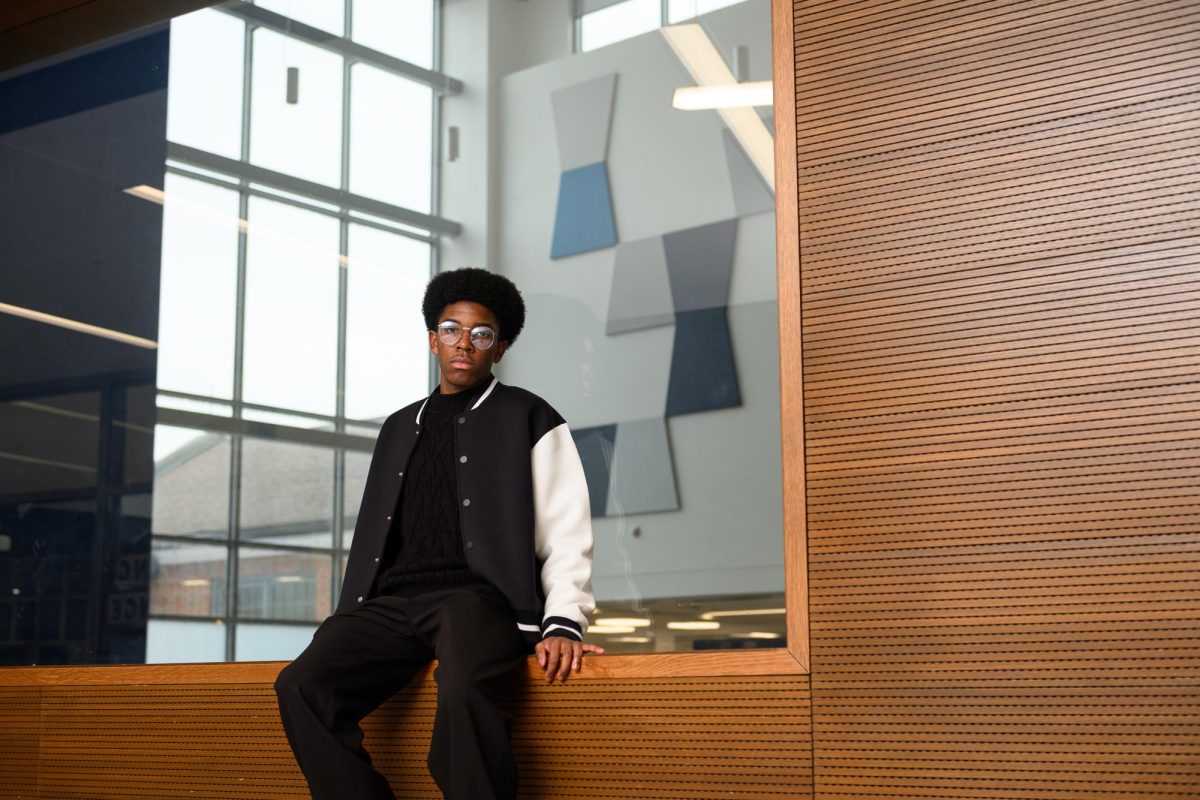
But one glance at the window cuts right through it. There’s her twin in the next-door gym, fresh from the mat. Wrestling meets are punctuated by teammates’ cheers and the thud of bodies, but despite this intensity, Nethmi Amarakone (12) still finds time to see her sister, to cheer her on.
Different sports. Different gyms. A wall of glass between them.
But even on opposite sides of the window, they haven’t forgotten where it all began: together.
New Lanes, New Mats
Nethmi and Nevinka were introduced to sports early on, starting with swimming at the age of 5, and continued until they joined the high school’s swim and water polo team in freshman year. For Nevinka, the sports clicked instantly. But while she’d found her place, Nethmi struggled. It was the summer before sophomore year, at a just-for-fun wrestling tournament for the girls’ water polo team, when Nethmi realized her wrestling talent for the first time.
“I wrestled all the girls in our team, and I beat all of them,” Nethmi said. “I already didn’t like swimming to an extent. I was the second slowest person in swim when I was a freshman. So I was like, ‘Okay, maybe I’ll just try wrestling, and if I don’t like it, I’ll just swim again.’”
The decision to switch wasn’t one Nethmi made easily. Not only was she quitting a sport she’d spent years training in for a completely new one, but she was also leaving her twin sister behind — something she’d never had to do before.
“It was a little weird at first,” Nethmi said. “Nevinka has always been faster than me, so we would be in different lanes [during swim]. Now, she wasn’t even in my view. She just wasn’t there. I was on my own. But I kind of liked that in a way, because we’ve always been competing since we were born. Either I would be a little bit better at her than something, or she would be better at me than something. I feel like this was the first time I had something that was my own.”
Although Nevinka supported her decision, adapting to swim alone was challenging.
“I had no problem with Nethmi prioritizing her own sports journey,” Nevinka said. “I wanted her to do something good for herself, and I wanted her to be in love with the sport that she wanted to do. That’s why I was actually proud of her for leaving. I wanted her to do well in wrestling. But I felt a little bit more alone. It just tested my mentality.”
However, as the weeks passed, both sisters came to terms with the separation. When Nethmi competed in her first tournament, she realized how much the new sport meant to her.
“I don’t think I’ve loved a hobby as much as I’ve loved wrestling,” Nethmi said. “Throughout my life, I’ve always gone with the flow and done whatever. Wrestling, I think, was one of the first things I really chose for myself.”
In the moment, the decision to split was difficult, especially since the twins had always been together. Reflecting on it now, however, they see it as a move that helped them develop individuality.
“I really think that us separating into our own sports helped,” Nevinka said. “People know that’s the swimmer, that’s the wrestler. That’s Nevinka, and that’s Nethmi.”
A Twin Thread
The twins have had a strong bond ever since they were little. Even their names seem to suggest it: Nevinka and Nethmi, always intertwined. Although they’ve grown into very different people, they feel they complement each other well.
“There are videos of us as babies jumping out of the bed, and Nevinka would shield me from falling,” Nethmi said. “Nevinka’s always been the protector. I think that’s why she’s so much more vocal than me.”
As they grew and developed their individual identities, the twins started to rely on each other less. Still, they didn’t let it put distance between them.
“Me and Nethmi aren’t very clingy twins,” Nevinka said. “We like doing what we individually like doing. [But] we’re both very similar. We make a lot of very similar choices, and we’re very teamwork-oriented. We care a lot. I see that in both of us.”
This passion hasn’t gone unnoticed by their classmates. Ruby Jurgiel (11), who is on the water polo team with both twins, has been consistently impressed by the dedication they show.
“They are both passionate players and fantastic teachers,” Jurgiel said. “One of my favorite memories with them is ‘rowing’ during the boys’ water polo games. This is how we cheer after each goal: one person, normally Nethmi, stands on the bleachers, while everyone else sits and pretends to row the number of goals our team has. Nevinka also has a big Ladue flag that she’ll wave. They work together to rally support and cheer our teams.”
Even with the separation, the twins have found ways to support each other in achieving their goals.
“I think we both encourage each other to be the best at our sports,” Nevinka said. “We just really want to be proud of something for ourselves, and we want to make the people looking up to us proud. We want to be good role models.”
Breaking the Mold
Neither swim, wrestling nor water polo are forgiving sports. With practice for hours every day after school, constant drills to complete and a continuous school workload to balance, the twins know firsthand how challenging it is to be an athlete.
“You need to be so disciplined in order to do well in swim,” Nevinka said. “You need to have a drive that is fueled purely by you. You want perfection out of everything, from your dive to your entry into the water, from your catch to your flip turns. You don’t want to waste any time.”
Wrestling, too, has its obstacles. P.E. teacher Kevin Clawson, who is the head coach for varsity wrestling, has helped multiple students with navigating it and is no stranger to its difficulties.
“Just the practices say it all,” Clawson said. “A wrestling match is six minutes. People believe that since it’s six minutes, it’s easy. But those six minutes are grueling.”
It’s not just the physical aspects of their sports that are demanding. Growing up Sri Lankan, the twins often felt unseen in the sports they played.
“From a young age, our parents have put us into sports or hobbies that have been predominantly white,” Nevinka said. “Being the only person of color, or darkest person in the room or in the pool, it’s made me feel lonely. I do feel connected to my culture, but sometimes the hobbies that I do or sports that I do make me want to push that part of me down.”
Being the minority, as the twins so often are, can be isolating. Although Nethmi has found many things to love about wrestling, the lack of representation frustrates her, too.
“Once in a while, I’ll realize, ‘Oh, I’m the only dark-skinned person in this room right now,’” Nethmi said. “I feel like there’s this pressure for me to do well, because I’m the only South Asian person who does wrestling. So, when I wrestle, I want to be noticed.”
Not only does wrestling lack cultural diversity, but it’s also male-dominated. When Nethmi joined the team in her sophomore year, there were just five girls on the team, and this number slowly dwindled. She decided to take action, posting flyers around the school to recruit from the Ladue community.
“I just made that poster and put my name on it so people can see that there’s another girl who was doing it at the moment, and they could,” Nethmi said. “Last year, I did that. This year, we have almost a full team. There’s a girl in every single weight class, and I’m just amazed by that. It just shows that girls are taking so much more interest in wrestling.”
While many sports have made strides in diversity, there are still underlying issues that the twins have had to confront. After four years on a team sport and more in club sports and extracurriculars, Nevinka knows how difficult it is to stay committed.
“I’m so proud of the girls who continue to persevere in their sports, despite being constantly let down or seen as other than,” Nevinka said. “I’m proud of them persevering through that other part of sports that is undeniably there. People like to pretend it’s not, but through all the locker room stuff and looks and microaggressions, it really is there. It’s impossible to isolate. Your identity [is] a part of you as a player. It’s undeniably who you are.”
Although the twins have had to deal with a lack of diversity in the sports they play, they try not to let it discourage them. Nevinka has even found a way to turn it into motivation.
“I see myself as a voice of representation, or a person of representation for people of color in general,” Nevinka said. “People see me as Indian or South Asian, or try to generalize me, and I’m okay with being generalized, if I can be the person that is an inspiration for darker skin tones, for other people in the audience to look up to me and be like, ‘Hey, she’s swimming, I can swim too.’”
The twins have also had to deal with cultural expectations. Their parents, although supportive, were doubtful at first that choosing untraditional sports was the right choice for their daughters. This pressure has only left Nethmi with more motivation to pursue the unorthodox.
“As a South Asian kid, just think about how many kids who are just forced to do only academics and maybe robotics and tennis and swimming, [who] never figure out they could be amazing at something that’s not the norm,” Nethmi said. “Sometimes, even if your parents say no, or if your friends are like, ‘Oh, why are you doing that,’ you have to try something. Even if you are hesitating about trying something new, you should always try it.”
By forging their own path, the twins hope to be inspirations for others.
“Ultimately, this sport will continue to be predominantly white or predominantly this and that if other people don’t choose to become their own representation,” Nevinka said. “My legacy will end here if no one else of color decides to follow through. Don’t just quit because you think that you’re not good enough, you’re not like other people. Let that boil, let that turn that into motivation, and let that pressure you to become the best.”
Why They Stay
Despite the grueling practice, conditioning and the isolation that both twins have faced, they have put in consistent effort, resulting in both sisters becoming team captains in junior year. This, more than anything, is why they stay: their fundamental passion for their sports.
“We’re extremely motivated,” Nevinka said. “We both really love our teams, and we really want to do anything possible to see the team as a whole succeed, not just ourselves. We carry our own successes through other people.”
Jurgiel has been on the swim team with Nevinka for three years and is often in the same lane with her during practice. Navigating the training can be difficult, but Jurgiel has found Nevinka to be a source of strength.
“During a particularly difficult swim set, Nevinka never failed to make me or our whole lane laugh,” Jurgiel said. “She is always able to bring out the best in everyone. Whenever we were losing, and I was particularly discouraged, she was always cheering me on the loudest. She gave me tips, brought the team together, and never failed to be my biggest supporter.”
Nethmi has also found her own place in her sport. To Clawson, her persistence in improving her skills is what makes her a great player.
“She has grown so much as a wrestler,” Clawson said. “In the beginning, she struggled, but I could see that spark in her eyes and her drive to get better. Wrestling is a sport where if you put in the effort, you see results. She worked really hard.”
Her teammate and wrestling partner, Aiyana Ungacta (10), has watched her hone her wrestling talent over countless meets and is inspired by her dedication.
“Nethmi is one of the most hard-working people I’ve ever met in my entire life,” Ungacta said. “Two years ago, she was an entirely different wrestler than she is now, and that’s because she puts in so much time and effort into becoming the type of wrestler she is. She’s helped me grow so much over these past couple of seasons. I would not be the wrestler I am today if it wasn’t for Nethmi.”
Swimming, and sports in general, demands much from athletes: effort, time, dedication. Nevinka has found the best way to keep going is to have a strong love for it.
“The biggest thing that motivates me to swim faster is intense emotion,” Nevinka said. “When I swim, when I’m done with an event, I’m crawling out of a pool, basically. I’m leaving everything in the water, everything in that match. Let sports drain you, and then let them build you up.”
This drive is a sentiment that unites the sisters. Nethmi’s passion for wrestling has helped her navigate the tougher sides of it.
“Despite being the only person of color, basically, in an all-white room of kids, and being one of only four girls in my club, my love for the sport erases all the hardships,” Nethmi said. “Whenever I have a bad practice, or I get extremely injured during a practice, or I feel like I just can’t get up anymore, my love for wrestling just overcomes everything.”
The twins’ love for sports has been a defining characteristic of their lives. To them, it’s always been about furthering their passion, being role models to others and most importantly, proving themselves.
“I just want to make my younger self proud of me,” Nevinka said. “I want to be what I’ve dreamt of being, someone that I could have looked up to when I was a kid.”
![Calvino Hammerman (11) stands and speaks at a podium. Hammerman testified independently at hearings, unaffiliated with any organization. “This is all independent for me,” Hammerman said. “I think it’s really important for average people [to be] going out there and sharing their voice, because that’s all I’m doing.”](https://laduetoday.com/wp-content/uploads/2026/01/Screenshot-2026-01-29-at-2.17.47-PM.png)
![Xinyi Lu waves his baton as he conducts concert orchestra class. For two years, he’s worked with Sarah Heuermann to direct Ladue’s orchestras. “[My favorite piece Ladue’s played] is Dies Irae, from last year,” Lu said. “The emotion of that piece is very strong, and I could clearly feel what Mozart [wanted] to express.”](https://laduetoday.com/wp-content/uploads/2026/01/Screenshot-2026-01-08-at-12.08.04-PM.png)
![Mortimer supports students during wrestling practice. Despite having participated in cross country and track in college, Mortimer had more motivation to coach wrestling. “Football and wrestling have always been my passions as far as coaching,” Mortimer said. “[They were] the sports that I enjoyed playing the most. I liked track and cross country, but I didn’t have any interest in coaching them.”](https://laduetoday.com/wp-content/uploads/2025/12/VEH_2364-1200x800.jpg)
![A young Vuohelainen skis on Levi, a resort in Lapland, Finland, and climbs at Sepänpuisto, a park near her house. Her time in the U.S. made her miss the familiarity of home. “[I] miss my friends and family [in Finland],” Vuohelainen said. “Everyone just clicked.” Photos courtesy of Iris Vuohelainen.](https://laduetoday.com/wp-content/uploads/2026/01/Screenshot-2026-01-08-at-11.07.21-AM.png)