
-
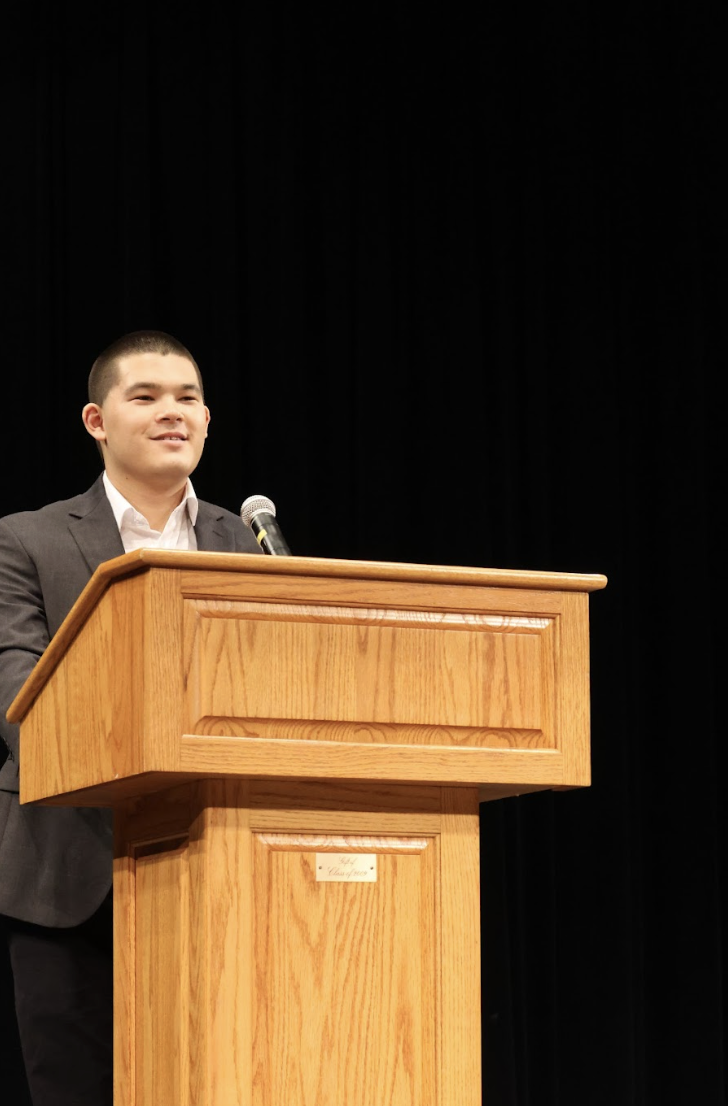
Calvino Hammerman (11) stands and speaks at a podium. Hammerman testified independently at hearings, unaffiliated with any organization. “This is all independent for me,” Hammerman said. “I think it’s really important for average people [to be] going out there and sharing their voice, because that’s all I’m doing.”
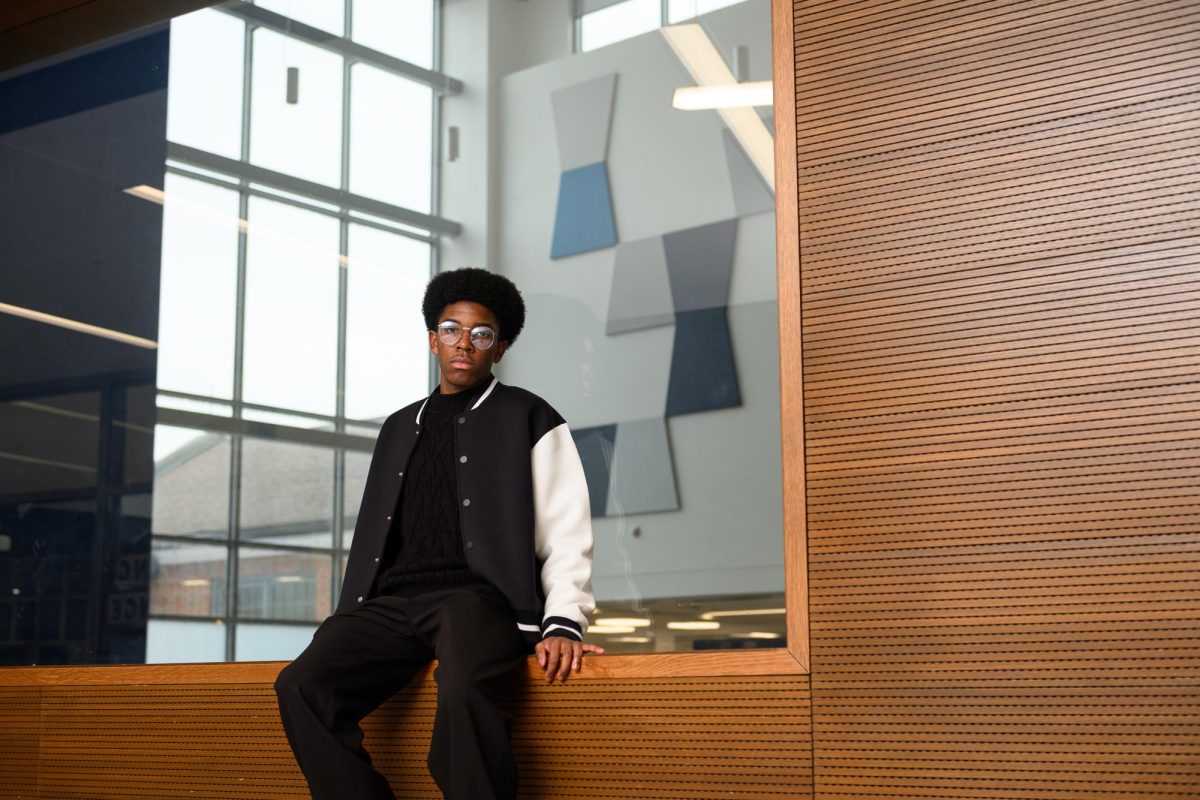
The chants tear through the foggy April air as more than 1,000 students pour out onto the muddy grass at Ladue Middle School. Signs thrust skyward. Voices crackle through megaphones. It’s noon, April 5, 2023, and Calvino Hammerman (11) stands at the center of the commotion he created—students surrounding him, news cameras rolling, administrators and teachers watching as their classrooms empty out in protest. A week after a gunman killed three students and three adults at a middle school in Nashville, Tenn., schools across the country planned to walk out in protest of gun violence in schools. Hammerman made sure Ladue would be one of them.
But Hammerman’s instinct for activism didn’t come out of nowhere. His mother, Amy Hammerman, serves as the State Policy Advocate for the National Council of Jewish Women and has spent years in activist spaces. At just 5 years old, Hammerman attended his first pride parade. By middle school, activism wasn’t a distant, adult endeavor—it was simply what people in his life did.
“I just got a strong sense of wanting to fight for what’s right,” Hammerman said. “Because I’ve been exposed to what real advocacy looks like, it never looked daunting to me. It never looked too hard, because I don’t believe it is. It’s just making the decision to do it. And because I’ve seen family members do it, I knew I could too, so it just seemed very obvious.”
Representing Senate District 24—including areas like Ladue, Creve Coeur, Des Peres, Kirkwood and Maryland Heights—Missouri State Sen. Tracy McCreery has been longtime family friends with the Hammerman family and watched Hammerman grow up.
“I think Calvino has truly been engaged in the community and caring about the community even when he was a young child,” McCreery said. “I noticed that when he was with his family at events, he truly was taking it all in. He wasn’t sitting in a corner playing on an iPad, killing time. He’s just a very compassionate person. He’s kind, and he truly wants to make the world a better place for other people.”
Attending Hearings
From January to May, Hammerman makes the drive to Jefferson City. There, he testifies at hearings on bills regarding K-12 education. Hearings are where he focuses most of his activism, missing about 25% of school to focus on advocacy. Besides hearings, Hammerman works on the other, more tedious side of advocacy: emails. The process is simple; he hears something on the news, does a little research and decides where he stands. From there, he drafts emails and sends it to multiple representatives.
“I focus my advocacy on school-related issues, mainly public school-related issues,” Hammerman said. “In the state of Missouri, unfortunately, I’m not advocating for a lot of good things. In my opinion, I’m advocating to stop bad things, trying to keep education free and what’s taught in schools free, and then in some places, advocating to add a certain curriculum.”
Hearings can draw anywhere from 10 people to 150, and sessions often start early and can drag on for hours. Speaking time varies by each bill from two minutes to as long as the speaker chooses. Regardless, Hammerman has learned to keep his speeches around 90 seconds, short enough to hold attention. At K-12 hearings, he is almost always the only student there.
“I’m the only person that has any close relation to schools there,” Hammerman said. “There’s not teachers because teachers are working during that time. There’s not principals because they’re working as well. There’s not students because most students don’t skip as much school as me.”
Hammerman describes himself as a moderate Democrat supporting freedom of speech and religion for all, and the bills he weighs in on reflects that. Whether his testimony influences how legislation plays out, Hammerman can’t say for certain. But he shows up regardless, believing that speaking up for what’s right matters.
“It’s hard to say whether I’ve made a direct impact, but I know the bills I’ve testified [for or against] have gone the way I wanted,” Hammerman said. “For instance, last year I testified against a bill that would require the Ten Commandments to be posted in schools. I didn’t like that, since [I believe in] the separation of church and state. And this year, we still don’t have the Ten Commandments in school.”
Hammerman has taken on numerous bills that relate to his Jewish faith as well. He has previously advocated for increased security funding for nonprofits, which is particularly important to him as a member of the Jewish community facing rising antisemitism.
“Calvino is very guided by his faith, and some of those values are making sure that people have access to food, clothing, shelter, health care and also making sure that people are not discriminated against,” McCreery said. “I think that is part of his guiding light.”
Connecting his faith with education, Hammerman has testified in Jefferson City, MO., for the requirement of Holocaust education in the Missouri curriculum. In addition, he has testified against the Parents Bill of Rights, which would allow guardians to have the right to review public school curriculum. It would also allow guardians to withdraw their child from specific classes or activities—including topics like the Holocaust or Black history.
“One [bill] I’m proud of that did pass was a bill to require Holocaust education, which as a Jewish person, I thought, ‘That’s important, we should probably learn about that,’” Hammerman said. “The state has all kinds of required curriculum. You can’t make it out of school without learning algebra. But until a few years ago, they weren’t required to teach what the Holocaust was.”
Canvassing
When McCreery was running for office in the 2022 Missouri Senate election, Hammerman canvassed for her campaign, knocking on doors across the St. Louis area. McCreery’s priorities align with Hammerman’s, such as increasing funding for education, expanding healthcare access and fighting discrimination.
“I think he was able to connect the dots and understand that, if you truly care about equality for all—about non-discrimination, about access to health care, clean air and water—it doesn’t matter how much you care if you elect people into office that don’t,” McCreery said. “I think Calvino has that unique ability to see how if you care about something, then you need to support candidates that actually have those same values and beliefs.”
Hammerman first started canvassing at the age of 8, going door-to-door on his own by the time he reached 10. He focuses on areas with more moderate political leanings, where he’s more likely to encounter people who haven’t settled on a particular political affiliation. Over time, he’s developed the ability to debate and persuade.
“I think it’s a really interesting skill,” Hammerman said. “The debate skills learned in your competitive Speech and Debate tournament doesn’t necessarily translate to talking to regular people. You’re trying to convince someone, but you’re trying to do it gently and talk to them like you’re their neighbor. They’re just another person. I’m just a regular person. It’s very different from the skills we learn in school, which are like, ‘You must cite your sources. You must use this language.’ It doesn’t work when you’re trying to just talk to a regular person. The average American doesn’t care whether you’re citing your sources in MLA format.”
That casual, door-to-door approach resonates, especially with older voters who make up most of the people canvassers meet. McCreery has seen firsthand how Hammerman’s age becomes an asset to her campaign.
“A lot of the voters that we talk to are in their 60s, 70s, 80s,” McCreery said. “I think that voters would find it inspiring that a high school student is coming out to talk to them about the importance of voting and the importance of participating. And although people under the age of 18 can’t vote [for] elected officials, we make decisions all the time that impact students of all ages.”
Hammerman’s strategy isn’t to overwhelm people with information. He opens with common ground, establishing where he’s coming from first.
“He’s very empathetic,” McCreery said. “He has excellent social skills. It’s pretty unusual for a young student to just be able to talk so easily to strangers. Those are life skills that will definitely serve him well as he matures and goes off to the rest of his life. There are families where parents sort of force their kids to volunteer, and you can always just tell that the students are really not that into it. But that’s not the case with Calvino; he seems to truly just have a fire in the belly for getting involved.”
Hammerman has visited Washington D.C. twice. In January, he went alongside the Religious Action Center of Reform Judaism to advocate for legislation addressing how antisemitism is defined and ensuring legal protections for political speech. In June, he was a part of the Cultural Leadership Fellowship, where he met Rep. Wesley Bell and Sen. Elissa Slotkin. But, overall, Hammerman’s real passion lies closer to home.
“I really care a lot more about state politics,” Hammerman said. “I’ve gone to D.C. and talked with representatives and senators and their staff. The thing for me with D.C. is that it’s at such a high level, and it just fills the news. I think people don’t realize how much it’s the state level politics that dictate exactly what their lives are like. That’s kind of scary, because it allows a loud minority to basically control our lives.”
Despite his trips to D.C., Hammerman has made the deliberate choice to invest his energy into state politics, believing that’s where he can make the biggest impact.
“Calvino’s focus on working to impact the state legislature makes sense to me, because that’s something that even a high school student can have an impact on,” McCreery said. “It’s much harder to get involved in a U.S. Senate race, or some of these other high-level, multi-million dollar giant races. So Calvino is focused on something that he actually can have an impact on, where he volunteered on my campaign. These smaller campaigns are a way for volunteers to be much closer to the candidate too.”
What’s Next
Hammerman also has an interest in pursuing music. In the future, Hammerman wants to attend the University of Illinois Urbana-Champaign for their music education and jazz program. After graduating, he hopes to later become a middle or high school band director.
“Music has kind of been the best thing for me throughout school,” Hammerman said. “It’s been my passion. I help teach little kids music, and it’s almost more satisfying for me to help them than for me to get something right. I really love it, and the profession sounds great. I get to be paid to talk about music all day. It sounds amazing.”
Hammerman’s true passion lies in jazz. Hammerman plays in Jazz St. Louis’ JazzU program, a tuition-free program that draws students from across Missouri to rehearse weekly and learn from professional jazz artists. In addition to being in the school band, he is currently in the Missouri All-Suburban and All-State Band.
“He’s a dedicated musician,” band director Aaron Lehde said. “He does a great job of taking advantage of every possible facet of things we offer here. If there’s something going on in the band world, he’s involved with it in some way shape or form, which is the absolute right attitude in terms of wanting to be a music educator and being an advocate.”
Funding for arts education is always vulnerable when school budgets shrink, but Hammerman sees the current threat as different. These controversial disputes over curriculum reach further than most realize. For Hammerman, they extend into places like the band room.
“Another reason I advocate for school stuff isn’t just because I want to be working in one,” Hammerman said. “You wouldn’t think the legislature would affect music education, but it does. For instance, learning jazz. What is jazz? It’s a music [genre] created by black people. If they ban black studies, how can we teach jazz? How can we teach the actual rich history of it? We won’t learn about jazz as a protest music, so it really touches all forms of education.”
The fight over arts funding goes beyond just budget lines. Lehde, who has taught Hammerman since sixth grade, has watched his student develop a deep love for music while simultaneously watching arts programs face increasing pressure. For Lehde, these funding cuts strike at what it means to be properly educated.
“Music is one of the essential elements of being a human being,” Lehde said. “You can’t consider yourself educated without music in your life. The arts often cost money, but it’s a way to make life bearable and woe is us who don’t take that part seriously. It helps to answer the questions, ‘Why are we here, and what are we doing? Why is life worth living?’ The arts provide that answer. When you talk about funding for the arts, you can’t start anywhere but the purpose of life.”
As Hammerman looks to the future, one thing is clear: he won’t stop showing up and speaking out. Those around him wouldn’t expect anything different.
“The sky’s the limit for Calvino,” McCreery said. “He seems to have it all, including a knack for being a good communicator. He will be able to do whatever he sets his mind to. And of course, he’s got support from people all over the place. He’s got a big village of people that are rooting for him and want him to be successful.”
![Xinyi Lu waves his baton as he conducts concert orchestra class. For two years, he’s worked with Sarah Heuermann to direct Ladue’s orchestras. “[My favorite piece Ladue’s played] is Dies Irae, from last year,” Lu said. “The emotion of that piece is very strong, and I could clearly feel what Mozart [wanted] to express.”](https://laduetoday.com/wp-content/uploads/2026/01/Screenshot-2026-01-08-at-12.08.04-PM.png)
![Mortimer supports students during wrestling practice. Despite having participated in cross country and track in college, Mortimer had more motivation to coach wrestling. “Football and wrestling have always been my passions as far as coaching,” Mortimer said. “[They were] the sports that I enjoyed playing the most. I liked track and cross country, but I didn’t have any interest in coaching them.”](https://laduetoday.com/wp-content/uploads/2025/12/VEH_2364-1200x800.jpg)
![A young Vuohelainen skis on Levi, a resort in Lapland, Finland, and climbs at Sepänpuisto, a park near her house. Her time in the U.S. made her miss the familiarity of home. “[I] miss my friends and family [in Finland],” Vuohelainen said. “Everyone just clicked.” Photos courtesy of Iris Vuohelainen.](https://laduetoday.com/wp-content/uploads/2026/01/Screenshot-2026-01-08-at-11.07.21-AM.png)